Dormancy and ecological stability
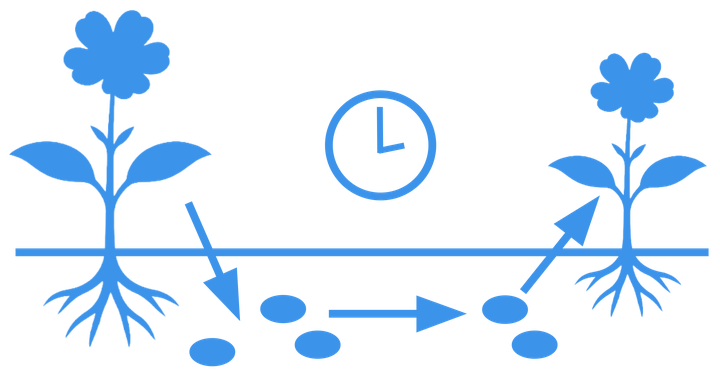
Many organisms can use dormancy to persist in a metabolically inactive state for long periods of time. Subpopulations of dormant individuals or their propagules - such as plant seeds, zooplankton eggs, and bacterial spores - can influence community dynamics far into the future. I study how the ecological memory created by these “seed banks” affects the stability, coexistence, and adaptability of communities. My work shows that dormancy can stabilize population dynamics, and reveals how dormancy interacts with ecological network structure to shape the stability of large communities. I am currently interested in understanding how dormancy - and other forms of ecological memory - creates trade-offs between ecosystem stability and adaptability. For example, as the climate warms, dormancy may buffer populations against more frequent extreme weather events, but also slow adaptation by introducing maladaptive gene flow from the past.
Key publications:
Dormancy stabilizes structured food webs (preprint)
Stabilisation of fluctuating population dynamics via the evolution of dormancy (2025) Ecology Letters
